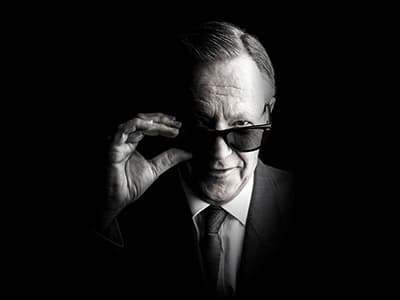
 Timberlake Wertenbaker. Now there's a name. Nothing to do with Justin, just to clarify, Wertenbaker (believe it, or not) is a British playwright, albeit with an Aussie connection, in the short, stocky, bearded and balding form of living national treasure, Tom Keneally. In 1988, presumably in honour, or mockery, of our bicentenary, TW debuted Our Country's Good, adapted from TK's novel, The Playmaker, at London's Royal Court (which seems apt).
 The production I attended, however, was staged at Manly's idyllic Star Of The Sea, by Rough Hewn Theatre Troupe, an initiative of Stella Maris College, in whose grounds the theatre resides. Rough Hewn, which has been running but a few years, can now boast that numerous of its members have graduated to various drama schools, including NIDA and the VCA. So there's no justification for any sniffiness in approaching this, or any other of their plays.
And the proof was in the pudding. The first thing I was struck by was my kind of set. As explicated in the directorial notes, because the theatre, though fully-fledged, moonlights as such, giving way to classes by day, the set must be struck after each performance, which tends to dicate a 'less is more' approach to design. Yay! I'm always ranting about how this throws focus onto performance, and it works here. We see a long line of nooses, with meat hooks, on which coats are hung, for fast, onstage costume changes (many actors have more than one role). Brilliant. And graphic. Other than that, about all that can be seen is numerous cubes, upon which the cast sit, when not actively engaged. Oh, and a pleasant surprise, at the back of the stage, where sits Michael Davis, who's composed and plays a tailor-made score, which speaks eloquently of the times and cultural extractions of convicts and officers.
Yes, convicts and officers, for this is a play about first-fleeters. It's not just about first-fleeters, for it concerns itself with an intellectual and philosophical dialectic about the value and power of theatre. This is woven into the historical fabric of the work. Without detailed research, I can't be sure if Keneally's and, thus, Wertenbaker's characterisations and narrative ring true, or are a preferred belief of what might've, could've, or should've taken place. Real would be gratifying; imagined is almost as good. If we are to take it as gospel, then His Excellency, Governor Arthur Phillip, emerges even more enobled, albeit somewhat emasculated by the assertiveness of several of his outspoken contemporaries.
It's a fine play. In fact, must-see. It's by no means it's first Australian outing, but this cast and crew do it admirable justice. The set we've spoken of, and credit is due to director Geoff Cartwright (also Artistic Director of the troupe), who doubles as Captain Arty, as well as verbose Jewish convict, John Wisehammer. Alongside him, the ever-present and versatile Louise Harding. Costumes derive from the very same and are exceptionally evocative of the era, without be faithful in a fussy way: the approach is impressionistic and all the less distracting and effective for it. Lighting design, by Mitchell Smith, is clever indeed, using all parts of the stage to maximum advantage. I've one or two notes for casting consultant Sher Guhl, inasmuch as the choice of the thickly and inappropriately-accented Exziles Dorvil, as Captain Watkin Tench, severely tested my capacity for suspension of disbelief.
The action begins with a flogging, emulated symbolically, and powerfully, with a soldier repeatedly striking a snaredrum, and counting. Meanwhile, spotlit stage-left, writhing against the wall, is the hapless recipient. Again, brilliant! This single stroke of veritable directorial genius suffices, on its own, to engage and compel.
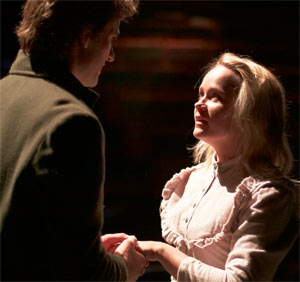
At the centre of the action is the fey and foppish Second Lieutenant, Ralph Clark, pining for his wife, and clearly out of his element and depth. Yet amidst his despair and loneliness, he conceives of something quite radical, not tom mention redemptive, for all concerned: to stage a production of George Farquhar's, The Recruiting Officer. But that's not the radical part. The radical part comes in his proposal the cast be comprised of convicts. Clark's own doubts, fears and prejudices are challenged in the doing and very much allayed by the supportive mentorship of Phillip, who transcends dissent in the ranks in giving his unequivocal rubber-stamp; or wax seal, perhaps. The civilising and humanising influence of theatre is rightfully trumpeted, while the nature and arbitrary practice of justice, in that and all times, is ruffled and agitated.
Alastair Buchanan is made-to-measure, as the hesitant, awkward and somewhat oblivious Clark, who struggles against his nature, upbringing, class, education and superior officers, becoming an advocate for convicts he formerly regarded as whores and reprobates. The quality and sensitivity of his performance is an ad for The Actors' Centre's Power of Performance course, which he's currently studying. On the strength of this role, which he delivers convincingly and with superb stagecraft, he's set to enjoy an illustrious career in theatre.
Andrew Drummond, a foundation member of RH, draws, presumably, on a Scottish heritage, to treat us with a quintessentially belligerent and abrasive Major Robbie Ross, with a flawlessly incorrigible brogue. Physically, too, he draws out every dramatic and comedic nuance. And when he changes hats, and accents, to become reluctant Irish hangman Ketch Freeman, the transformation is consummate and note-perfect.
Chris Turner complements Drummond's Major, as sycophantic counterpart, Captain Jeremy Campbell, upping the comedic ante by taking the brogue one step further into the realm of outrageous ridicule, in making it utterly unintelligible, while retaining an utterly convincing cadence. He boasts two other roles: as the jealous, schizoid and ill-fated Midshipman Harry Brewer, and the criminal John Arscott. All three performances are more than creditable. Much more.
Courtney Farrow displays a similar versatility: even without truly adequate costuming, she effects the masculine mannerisms and arsy demeanour of the unforgiving Reverend Johnson, as well as the demure con, Mary Brenham.
Jess Keily is also commanding as Mary's forthright friend, Dabby Bryant.
Jenna Martin fulfils her demanding role as deathrow lady-in-waiting, Liz Morden, who has all but surrendered to her unjust fate and the corruption that attends and would see it enforced.
And now-familiar Katherine Lunny again brings her ample bosom and talent to the role of wench, Duckling Smith.
There are other double-ups and actors I've failed to mention. Those I have were, on the whole, the most memorable, striking, consistent, and persuasive, for mine. Which, I stress, is no discredit to the others.
This is a surprisingly first-rate production from this pro-am company. Sure, I imagine some notes would apply, after this, opening night. But if the 'dead air' can be filled, and a few bumps ironed-out, there won't be much left to criticise. There will be, however, plenty to appreciate. Including the play itself.
Cap'n Arf'r sums it up neatly: 'we will laugh, we may be moved, we may even think a little'. I'd be stunned if you don't derive all of those rewards, from this not so roughly-hewn production.
PS. My only 'tsk, tsk', finger-waving, high-handed complaint, of any significance or substance, is the relegation of the Aboriginal perspective on invasion to little more than dutiful tokenism (even if this fault probably lies, ostensibly with the play, and not the production): selecting a black actor isn't enough. It would be gratifying to think a young, or older, Aboriginal actor could be found to add authenticity, credibility, pathos and impetus to a role which is already too minor and marginalised. Colour, as such, should not be the criterion, but if one is to go down that track, then a blackfella, or woman, with relative cultural attachment is, realistically, the only approach to take. The actor cast shows every sign of being very capable, but seemed self-conscious, perhaps aware of his own unsuitability, in this context.
Rough Hewn Theatre Troupe presents
Our Country's Good
by Timberlake Wertenbaker
Director Geoff Cartwright
Venue: The Star of the Sea Theatre | corner Collingwood St and Iluka Ave, Manly
Dates: Mar 18 - 27, 2010
Times: Thursday to Saturday nights at 7.30pm
Tickets: $20 adults, $15 concession
Bookings: www.trybooking.com/DMH | at the door